
How to Price Your Offers Without Undercharging (Beginners)
Most Christian entrepreneurs under-price out of fear or false humility. Learn how to price with biblical integrity—not desperation. Free structural audit inside.
3/17/202613 min read


THE PROBLEM WITH UNDERPRICING
You're undercharging. Not because you're generous. Because you're afraid. Afraid no one will buy if you charge what you're worth. Afraid people will think you're greedy. Afraid you'll price yourself out of the market. So you charge $27 for a service that should be $297. You offer payment plans for $47 products. You discount before anyone even asks.
And you tell yourself: "I'm just starting. I need to build credibility first. I'll raise my prices later." But "later" never comes. Because under-pricing doesn't build credibility. It builds resentment. You resent the clients who pay you $50 for 3 hours of work. You resent the people who buy your $27 course and expect $297 results. You resent yourself for working 60-hour weeks and still being broke. And eventually, you quit. Not because you're not talented. Not because you're not called. Because you built a business on desperation pricing—and desperation pricing doesn't sustain.
Here's the truth most Christian entrepreneurs don't want to hear: Under-pricing is not humility. It's disobedience. Proverbs 11:1 (KJV) states, "A false balance is abomination to the Lord: but a just weight is his delight." A false balance means charging less than the value you provide—or charging more than the value you deliver. Both are corruption. And if you're undercharging out of fear, false humility, or desperation—you're operating with a false balance.
This article will show you why you're undercharging (and it's not because you're humble), what biblical pricing actually means (it's not "charge as little as possible"), how to build revenue structure so you can monetize without manipulation, and how to price your offers with integrity—even when you're just starting.
WHY CHRISTIAN ENTREPRENEURS UNDERPRICE
It's Not Humility—It's Fear, False Doctrine, or Lack of Structure
Most Christian entrepreneurs under-price for one of three reasons: fear (of rejection, of being perceived as greedy, of not being "good enough"), false doctrine (misapplied Scripture about money, poverty gospel, prosperity guilt), or lack of revenue structure (they don't know how to price because they have no framework).
Fear
You're afraid no one will buy if you charge what you're worth. So you charge $50 for a service that should be $500. You offer discounts before anyone asks. You apologize for your prices. And every time someone books you at $50, you think: "See? People will only pay me this much. If I charged more, I'd get no clients." But that's not true. You're attracting clients who can only afford $50 BECAUSE you're charging $50. If you charged $500, you'd attract clients who value $500-level work.
Here's the structural problem: When you price from fear, you attract clients who expect cheap work. And cheap clients are high-maintenance clients. They question everything. They ask for refunds. They expect $500 results for $50 prices. And you end up working harder for less money—and resenting every client you serve. This is not sustainable.
Proverbs 29:25 (KJV) warns, "The fear of man bringeth a snare: but whoso putteth his trust in the Lord shall be safe." Fear-based pricing is a snare. It traps you in a cycle of undercharging, overworking, and resenting your clients. If you're pricing from fear, you're not operating from faith. You're operating from scarcity. And scarcity-based pricing doesn't build Kingdom businesses. It builds burnout.
False Doctrine
You've been taught that Christians should "serve freely" or "not charge too much" or "be humble about money." So you under-price because you think charging full value is greedy. You discount because you think generosity means charging less. You apologize for your prices because you think humility means undervaluing your work. But that's not what Scripture teaches.
Example #1: The Labourer Is Worthy of His Hire. Luke 10:7 (KJV) states, "And in the same house remain, eating and drinking such things as they give: for the labourer is worthy of his hire. Go not from house to house." The labourer is WORTHY of his hire. Not "the labourer should work for free" or "the labourer should charge as little as possible." Worthy of his hire. That means you charge what the work is worth—not what your fear tells you people will pay.
Example #2: A Just Weight. Proverbs 11:1 (KJV) repeats, "A false balance is abomination to the Lord: but a just weight is his delight." A just weight means charging FAIR value. Not undercharging. Not overcharging. Fair. If you provide $500 of value and charge $50, that's a false balance. If you provide $50 of value and charge $500, that's also a false balance. Both are corruption. Under-pricing is not humility. It's a false balance. And God calls a false balance an abomination.
Example #3: The Priests Were Paid. The Levitical priests didn't work for free. They were sustained by the tithes and offerings of the people. Numbers 18:21 (KJV) records, "And, behold, I have given the children of Levi all the tenth in Israel for an inheritance, for their service which they serve, even the service of the tabernacle of the congregation." The priests served God full-time. And they were sustained by the people they served. They didn't apologize for receiving provision. They didn't under-price their ministry. They stewarded the provision God released through the people. If you're under-pricing because you think Christians should "serve for free," you're operating from false doctrine—not biblical truth.
Reason #3: Lack of Revenue Structure
You don't know how to price because you have no revenue structure. You have one offer. One price point. No ascension path. And because you only have one price point, you're trying to serve EVERYONE at that price point: the person who can afford $50, the person who can afford $500, and the person who can afford $5,000. But you can't serve all three at $50. Because the person who can afford $5,000 won't buy a $50 offer. They'll assume it's low-quality. And the person who can only afford $50 will expect $5,000 results for $50.
This is why you need revenue structure. Revenue structure means you have multiple price points that serve different levels of buyers. For example: $0 (Free Lead Magnet) attracts people who need to know you're credible before they buy; $27 (Entry-Level Offer) serves people who can't afford more but want access; $147 (Core Offer) serves people who are ready to invest in transformation; $497 (Premium Offer) serves people who want done-with-you support; and $2,000+ (High-Touch Offer) serves people who want done-for-you or custom work. Now you're not trying to serve everyone at $50. You're serving people at the level they can afford—and the level of transformation they're ready for. Without revenue structure, you'll always under-price. Because you're trying to make ONE price point work for EVERYONE. And that's not sustainable.
WHAT BIBLICAL PRICING ACTUALLY MEANS
It's Not "Charge as Little as Possible"—It's "Charge a Just Weight"
Biblical pricing doesn't mean charging as little as possible. It means charging FAIR value. Proverbs 11:1 (KJV) establishes this: "A false balance is abomination to the Lord: but a just weight is his delight." A just weight means you charge what the transformation is worth (not what your fear says people will pay), you deliver the value you promise (no overcharging for under-delivery), and you price with integrity (no manipulation, no false urgency, no deceptive tactics).
Biblical Pricing Principle 1: Charge What the Transformation Is Worth (Not What the Work Costs You)
Most Christian entrepreneurs price based on TIME. They think, "This takes me 3 hours, so I'll charge $150 (at $50/hour)." But that's not biblical pricing. That's hourly wage thinking. Biblical pricing is based on TRANSFORMATION. It considers, "This solves a $10,000 problem. I'll charge $1,000 (10% of the value it provides)."
For example, you're a business coach. You help Christian entrepreneurs install biblical business structure so they stop pivoting every 6 months. Time-based pricing would say, "I spend 6 hours with each client, so I'll charge $300 (at $50/hour)." Transformation-based pricing would say, "My clients stop wasting $10,000–$50,000 per year on failed launches and constant rebranding. I'll charge $2,000 for 90 days of coaching." See the difference? One prices based on YOUR cost (time, effort, energy). The other prices based on THEIR transformation (the problem you solve, the value you provide). Biblical pricing is transformation-based, not time-based.
Biblical Pricing Principle 2: Deliver the Value You Promise (No Overcharging for Under-Delivery)
Proverbs 20:10 (KJV) warns, "Divers weights, and divers measures, both of them are alike abomination to the Lord." This means: Don't promise $5,000 transformation and deliver $500 results. If you charge $2,000 for coaching, you better deliver $2,000 worth of transformation. If you charge $500 for a course, it better solve a $5,000+ problem. Overcharging for under-delivery is corruption. Just like undercharging is a false balance, overcharging is also a false balance. Both are abomination to the Lord. Biblical pricing means: Charge what it's worth. Deliver what you promise.
Biblical Pricing Principle 3: No Manipulation, No False Urgency, No Deceptive Tactics
Proverbs 11:1 (KJV) continues to be the standard: "A false balance is abomination to the Lord: but a just weight is his delight." False balance includes fake scarcity ("Only 3 spots left!" when you have unlimited capacity), fake urgency ("Price goes up at midnight!" when you'll run the same sale next week), manipulative language ("If you don't buy this, you'll stay stuck forever"), and deceptive pricing ("Was $997, now $97!" when it was never $997). All of these are false balances. And God calls them abomination. Biblical pricing means: Charge fair value. Use honest marketing. No manipulation.
HOW TO BUILD REVENUE STRUCTURE (SO YOU CAN STOP UNDERPRICING)
Why One Price Point Keeps You Broke—And How to Fix It
Here's the structural problem with under-pricing: You have ONE offer. ONE price point. And you're trying to serve EVERYONE at that price. But not everyone can afford the same price. And not everyone needs the same level of transformation. This is why you need revenue structure. Revenue structure means you have multiple price points that serve different buyers at different levels of readiness.
Step 1: Create a Free Lead Magnet ($0)
Purpose: Attract people who need to know you're credible before they buy. Examples include a Free Biblical Business Structural Audit (diagnostic that reveals gaps), a Free 5 Biblical Principles guide (teaches one framework), or a Free workshop or webinar (teaches + pitches core offer). This is NOT charity. This is STRATEGY. The free offer builds trust. It shows you know what you're talking about. It qualifies leads (people who take the free audit are MORE likely to buy the paid offer).
Step 2: Create an Entry-Level Offer ($27–$47)
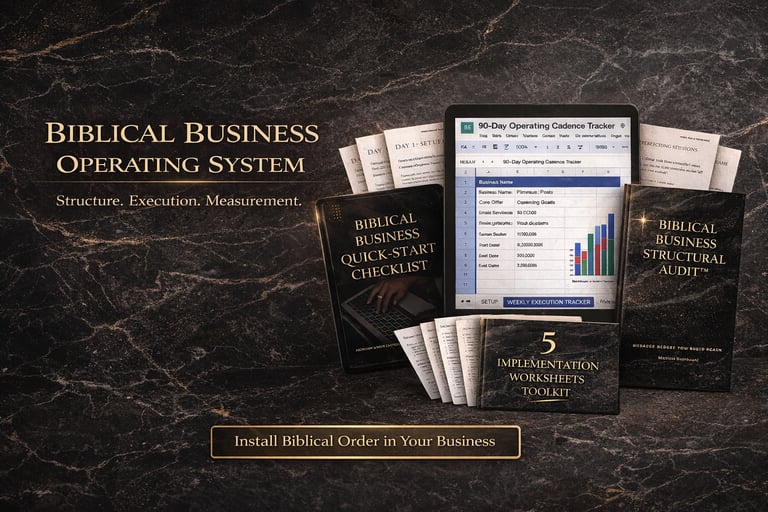
Purpose: Serve people who can't afford more but want access. Examples include a 90-Day Cadence Tracker ($27), a Quick-Start Checklist ($37), or a single worksheet or template ($27). This is your "foot in the door" offer. It's low-commitment, high-value, easy YES. And it introduces people to your systems so they're ready to ascend to the core offer.
Step 3: Create a Core Offer ($147–$297)
Purpose: Serve people who are ready to invest in transformation. Examples include the Biblical Business Operating Order™ Manual ($147), a Complete Installation Toolkit ($197), or a 30-day program or course ($197). This is your PRIMARY revenue driver. Most of your income will come from this price point.
Step 4: Create a Premium Offer ($497–$997)
Purpose: Serve people who want done-with-you support or expanded access. Examples include BBOO Manual + 90-Day Coaching ($497), a Group coaching program ($697), or an Implementation intensive ($997). This serves people who want ACCOUNTABILITY + SUPPORT, not just information.
Step 5: Create a High-Touch Offer ($2,000+)
Purpose: Serve people who want done-for-you or custom work. Examples include 1-on-1 coaching (6 months, $3,000), Custom business structure audit + implementation ($5,000), or a VIP day ($2,500). This serves high-level buyers who want custom solutions, not templates.
Now you have FIVE price points: $0 (Free Audit) serves people who need proof before they buy; $27 (90-Day Tracker) serves people who want tools but can't afford coaching; $147 (BBOO Manual) serves people ready to install structure; $497 (BBOO + Coaching) serves people who want accountability; and $2,000+ (Custom Coaching) serves people who want done-for-you solutions. Now you're not under-pricing. You're serving people at the level they can afford—and the level of transformation they're ready for.
HOW TO PRICE YOUR OFFERS (EVEN WHEN YOU'RE JUST STARTING)
Five Pricing Principles That Work for Beginners
You're just starting. You don't have testimonials. You don't have case studies. You don't have a track record. So how do you price without undercharging? Here are five principles.
Pricing Principle 1: Price Based on Transformation, Not Experience
You don't need 10 years of experience to charge $500. You need to solve a $5,000 problem. For example, you're a brand new business coach. You help Christian entrepreneurs stop pivoting every 6 months. You don't have testimonials yet. But you KNOW your framework works (because you used it yourself). Don't price like this: "I'm new, so I'll charge $50 for coaching." Price like this: "My framework helps entrepreneurs stop wasting $10,000–$50,000 per year on failed launches. I'll charge $1,000 for 90 days." You're not charging for YOUR experience. You're charging for THEIR transformation.
Pricing Principle 2: Start at 50% of Market Rate, Not 10%
If the market rate for your service is $2,000, don't charge $200. Charge $1,000. Why? Because $200 signals "I'm desperate" or "I'm not confident in my work." But $1,000 signals "I'm new, so I'm offering a discount—but my work is still valuable." You're not underpricing. You're offering a strategic discount. And as you gain testimonials, you raise your prices to full market rate.
Pricing Principle 3: Offer "Founding Member" Pricing (Time-Limited, Not Desperation-Based)
If you're brand new, offer "founding member" pricing for your first 5–10 clients. For example: "I'm launching my biblical business coaching program. The full price will be $2,000. But I'm offering founding member pricing at $1,000 for the first 5 clients. You'll get the same program at 50% off—and I'll use your feedback to refine the system." This is strategic discounting, not desperation pricing. You're not apologizing for your prices. You're offering a limited-time opportunity for early adopters.
Pricing Principle 4: Don't Discount Without a Reason
Never discount just because someone asks. If you offer a discount, it should be strategic: Founding member pricing (first 5–10 clients), Referral discount (they bring 3 paying clients, they get 20% off), or Early-bird pricing (sign up 2 weeks early, get 15% off). But never discount out of fear or desperation. Because every time you discount without a reason, you train clients to expect discounts. And then you can never raise your prices.
Pricing Principle 5: Raise Your Prices Every 10 Clients
Every 10 clients, raise your prices by 20–30%. For example: Clients 1–10 pay $1,000; Clients 11–20 pay $1,300; Clients 21–30 pay $1,700; Clients 31+ pay $2,000 (full market rate). This does three things: It rewards early adopters (they got the lowest price), it builds urgency (if you wait, the price goes up), and it prevents you from staying stuck at beginner pricing forever. By the time you've served 30 clients, you're charging full market rate. And you have 30 testimonials to justify it.
WHY UNDERPRICING IS DISOBEDIENCE (NOT HUMILITY)
False Humility Keeps You Broke—Biblical Stewardship Builds Sustainable Businesses
Let me say this clearly: Under-pricing is not humility. It's disobedience. Here's why: Under-pricing is a false balance (Proverbs 11:1). Under-pricing devalues the work God assigned you (you're saying God's assignment isn't worth full value). Under-pricing prevents you from stewarding increase (you can't tithe 10% if you're only making $500/month). Under-pricing attracts cheap clients who don't value transformation (and then you resent them). Under-pricing keeps you in survival mode (and survival mode is not sustainable).
Proverbs 11:24–25 (KJV) teaches, "There is that scattereth, and yet increaseth; and there is that withholdeth more than is meet, but it tendeth to poverty. The liberal soul shall be made fat: and he that watereth shall be watered also himself." Notice: Withholding more than is meet tends to poverty. That means: If you're undercharging (withholding fair value from yourself), you're trending toward poverty. Under-pricing doesn't build Kingdom businesses. It builds resentment, burnout, and eventual collapse. If you want to build a sustainable business, you have to price with integrity. Not desperation. Not false humility. Integrity. Charge what it's worth. Deliver what you promise. Build revenue structure so you can serve people at every level. That's biblical pricing.
WHAT TO DO RIGHT NOW
Take the Free Biblical Business Structural Audit
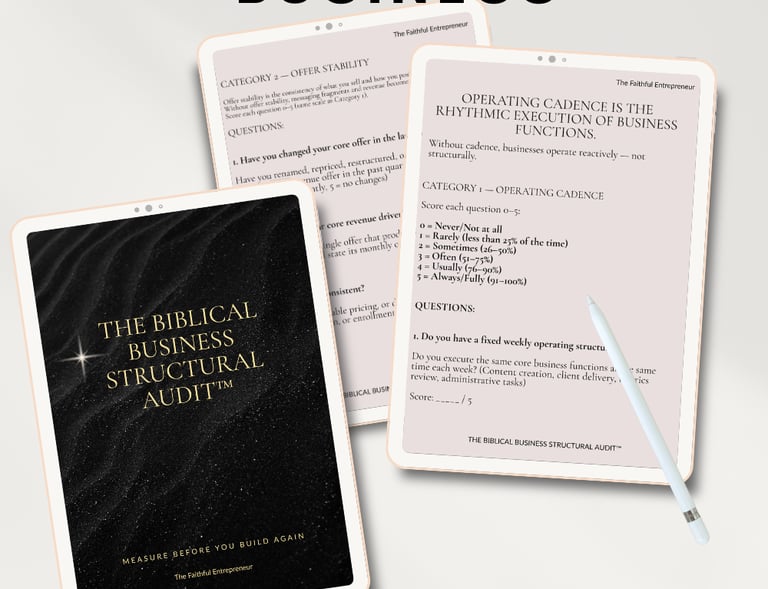
Before you can price with integrity, you need to know where your structural gaps are. The Biblical Business Structural Audit™ is a free 25-question diagnostic that measures Operating Cadence (are you working reactively or with rhythm?), Offer Stability (do you have a stable offer or are you pivoting constantly?), Authority Infrastructure (do you know what this business is assigned to do?), Revenue Structure (do you have multiple price points or just one?), and Biblical Order Alignment (are you building with biblical principles or worldly tactics?). It takes 10 minutes. And it shows you exactly where instability exists—including whether you have revenue structure.
Take the free audit If you score 0–40 (Foundational Disorder), you don't have revenue structure yet. Start with the Complete Installation Toolkit, which includes the 30-Day Quick-Start Checklist, 90-Day Operating Cadence Tracker, and 5 Implementation Worksheets. This installs foundational biblical order so you can build revenue structure.
If you score 41–75 (Structural Instability), you have some structure, but your pricing is unstable. Get the Biblical Business Operating Order™ Manual ($147). Section V teaches Monetization Without Corruption (biblical pricing, revenue structure, offer stability). If you score 76+ (Developing Order or Scalable Foundation), you have structure. Now you need to track what's working. Add the 90-Day Operating Cadence Tracker ($27) to measure which offers convert.
Last Thoughts
You're not under-pricing because you're humble. You're under-pricing because you're afraid. Or because you've been taught false doctrine. Or because you don't have revenue structure. But none of those are good reasons to keep charging $50 for $500 work.
Proverbs 11:1 (KJV) declares, "A false balance is abomination to the Lord: but a just weight is his delight." Charge a just weight. Not under-pricing. Not overcharging. Fair value. And build revenue structure so you can serve people at every level—without burning out, resenting your clients, or collapsing under the weight of desperation pricing.
Take the free Biblical Business Structural Audit at The Biblical Business Structural Audit | The Faithful Entrepreneur Store Install the Biblical Business Operating Order. Build revenue structure. Price with integrity. Then watch what God does when you steward His assignment with biblical order.

Stay faithful. Build in order. Operate with discipline.
With clarity and fire,
V.S. Beals
Biblical Business Systems Architect
V.S Beals
valerie@thefaithfulentrepreneur.store


Ordained Minister · Author of 20+ Published Titles · Toronto, Ontario