
What Is a Biblical Business? How to Transition from a Secular Business Model to a Kingdom-Based Business System
Learn what a biblical business truly is and how to transition from a secular business model to a Kingdom-based system. Discover the 6 foundational differences every Christian entrepreneur must understand to build a business led by Scripture, not the market.
BIBLICAL BUSINESS 101
V.S Beals
3/26/20266 min read


Understanding the Foundational Differences
I've been writing about Biblical business and how to make money online for quite some time now and just realised that I haven't actually really broken down what a Biblical business actually is. So this week my beautiful entrepreneurs, we're going to uncover what an actual Biblical business is.
Let's get right to it.
Transitioning from Secular to a Biblical Business
The decision to transition from a secular business model to a biblical one is not merely a branding adjustment or a shift in marketing language. It is a structural overhaul—a complete reordering of the foundation upon which a business is built, operated, and evaluated. Before any entrepreneur can make that transition effectively, she must first understand what she is walking away from and what she is walking into. These two systems do not simply differ in tone; they differ in origin, authority, motivation, measurement, and design.
This article establishes those foundational differences across six core categories: authority, purpose, success metrics, ethics, leadership, and resource management. Each category reveals not just what separates the two models, but why those separations matter to the entrepreneur who is committed to building something that lasts.
Authority: Who Governs the Business
The most fundamental difference between a secular and a biblical business is the question of authority. In a secular business model, the governing authority is market demand. The entrepreneur makes decisions based on what sells, what trends, what competitors are doing, and what investors or customers require. The final arbiter of every major decision is human—whether that is the CEO, the board, the market researcher, or the consumer.
In a biblical business model, the governing authority is Scripture. Proverbs 3:5-6 establishes this principle explicitly: "Trust in the LORD with all thine heart; and lean not unto thine own understanding. In all thy ways acknowledge him, and he shall direct thy paths" (KJV). The biblical entrepreneur does not consult only human wisdom. She consults the Word first. Business decisions—from pricing to partnerships to expansion—are filtered through biblical precept before they are finalized.
This does not mean the biblical business ignores market research or financial analysis. It means those tools serve under the authority of Scripture, not above it. The secular model elevates human intelligence. The biblical model submits it.
Purpose: Why the Business Exists
Secular businesses are built on value propositions—the articulation of what the business offers to the consumer in exchange for money. While purpose-driven branding has become popular in secular spaces, the purpose is still fundamentally human-centered: solve a problem, fill a gap, generate revenue, build wealth, or achieve personal freedom.
The biblical business operates under a different mandate. Its purpose is not limited to market value; it is anchored in Kingdom assignment. Ephesians 2:10 states, "For we are his workmanship, created in Christ Jesus unto good works, which God hath before ordained that we should walk in them" (KJV). The biblical entrepreneur understands that her business is one expression of those ordained good works. It is not simply what she does to earn income—it is what she was built to do for a purpose that extends beyond her personal gain.
This reorientation of purpose changes everything downstream. It affects who the business serves, how it prices its offerings, what partnerships it accepts, and what success ultimately looks like. A business built for Kingdom assignment will make different decisions than one built for market dominance.
Success Metrics: How the Business Measures Progress
Secular businesses measure success through quantifiable performance indicators: revenue, profit margins, customer acquisition cost, return on investment, market share, and growth rate. These are not inherently wrong metrics, but they are incomplete when applied to a biblical business without biblical counterweights.
The biblical business measures success through a dual accountability framework. Financial stewardship is one layer—and it is taken seriously, because Proverbs 27:23 commands, "Be thou diligent to know the state of thy flocks, and look well to thy herds" (KJV). But biblical success also measures faithfulness: Was the business operated with integrity? Did it serve its assigned people well? Did it advance Kingdom purposes? Was the entrepreneur obedient to what God instructed, even when the numbers did not immediately reward that obedience?
The secular model rewards results. The biblical model rewards faithfulness first, and trusts that results follow alignment. Matthew 6:33 frames this sequence clearly: "But seek ye first the kingdom of God, and his righteousness; and all these things shall be added unto you" (KJV).
Ethics: How the Business Operates
Secular business ethics are governed by legal standards, industry norms, and reputational risk management. A secular business avoids certain behaviors because they are illegal, because they damage brand perception, or because they carry financial liability. The ethical floor is compliance.
Biblical business ethics are governed by a higher standard than compliance. They are governed by covenant. The biblical entrepreneur does not simply ask, "Is this legal?" She asks, "Is this righteous?" Micah 6:8 articulates the standard: "He hath shewed thee, O man, what is good; and what doth the LORD require of thee, but to do justly, and to love mercy, and to walk humbly with thy God" (KJV). Justice, mercy, and humility are operational principles—not marketing values displayed on a website, but structural commitments that shape how the business handles its vendors, employees, customers, and competitors.
This means the biblical business may decline revenue opportunities that conflict with its covenant commitments. It may price fairly even when the market would allow gouging. It may treat a difficult client with mercy rather than escalation. These are not weaknesses in the business model; they are expressions of its architectural integrity.
Leadership: Who the Business Serves
Secular leadership models prioritize the leader. Even servant leadership in secular contexts is often framed as a strategy for achieving organizational outcomes—teams perform better when leaders serve them. The motivation remains performance-centered.
Biblical leadership is not a strategy; it is a posture. It flows from the model established in Mark 10:43-45, where Jesus defines leadership as servanthood: "Whosoever will be great among you, shall be your minister: And whosoever of you will be the chiefest, shall be servant of all" (KJV). The biblical business leader does not position herself above her clients or team—she positions herself as a steward of their development and well-being. Her authority is real, but it is exercised in service, not dominance.
This reframes the entire client relationship. The secular entrepreneur builds a customer base. The biblical entrepreneur builds a people. There is a covenant dimension to how she serves—one that cannot be replicated through a secular loyalty program or a client experience framework.
Resource Management: How the Business Handles Provision
In a secular business, resources—capital, time, talent, opportunity—are owned by the entrepreneur and managed according to personal preference, financial strategy, and organizational need. The business owner decides how to allocate what is hers.
In a biblical business, resources are not owned—they are stewarded. Deuteronomy 8:18 establishes this clearly: "But thou shalt remember the LORD thy God: for it is he that giveth thee power to get wealth, that he may establish his covenant" (KJV). Every resource available to the biblical entrepreneur was given to her for a purpose that transcends her personal ambition. She manages money, time, team, and opportunity as a steward accountable to the One who provided them.
This shifts the entire framework of financial decision-making. Generosity is not optional; it is structural. Integrity in financial reporting is not just ethical—it is covenantal. The biblical entrepreneur does not just manage a budget. She manages a trust.
The Difference Is Structural, Not Superficial
The six distinctions that I outlined here—authority, purpose, success metrics, ethics, leadership, and resource management—make one thing clear: the gap between a secular business and a biblical one is not closed by adding a scripture to a website header or opening team meetings with prayer. It requires a full architectural audit of who governs the business, why it exists, how it measures its own performance, how it treats people, and how it manages what it has been given.
Understanding these differences is the prerequisite for conversion. The entrepreneur who cannot articulate what she is converting from will not be able to execute the conversion with integrity. Part II of this series, Biblical Business 101, provides the operational framework for that transition.
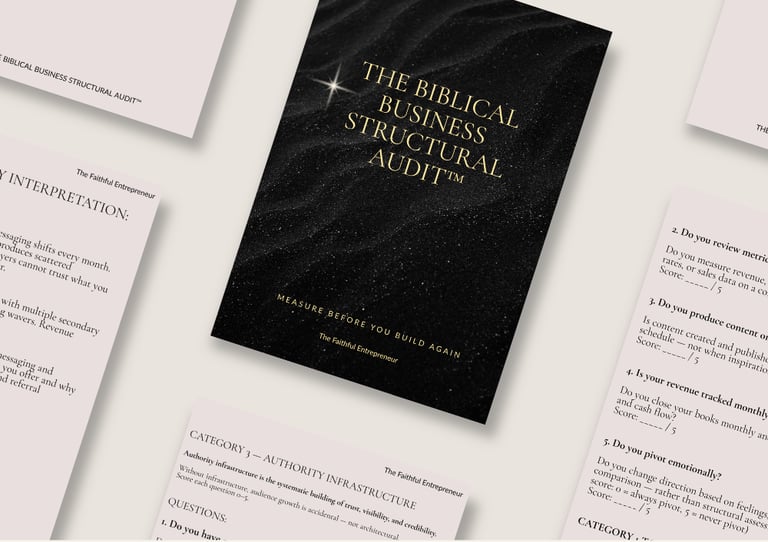
The Biblical Business Audit
Not sure where to start? Download our Free Biblical Businesstural Audit Today
Stay faithful. Build in order. Operate with discipline.
With clarity and fire,
V.S. Beals
Biblical Business Systems Architect
V.S Beals
valerie@thefaithfulentrepreneur.store


Ordained Minister · Author of 20+ Published Titles · Toronto, Ontario