
What if I told you that it is IMPOSSIBLE for you to fail
This week we're exploring the gauranteed promise of success. What if no matter what niche or market you're in you couldn't fail.
V.S Beals
2/11/20265 min read


What if I told you that it is IMPOSSIBLE for you to fail at what God called you to do?
Not difficult. Not unlikely. IMPOSSIBLE.
Because if God made your mouth, chose your weakness, and called you anyway, failure isn’t even an option. Let me show you the proof.
This month, we’ve been diving deep into biblical patterns. Last week, we broke down Joseph’s 13-year journey from the pit to the palace. This week, we’re tackling the biggest thing that stops you from walking in your calling: your mind.
It’s not that you don’t believe God’s Word is true. The problem is that the enemy’s thoughts are so loud in your head that you can’t cancel them out. You can’t make room for what Father is actually saying.
Today, I’m giving you three biblical characters who had the exact same enemy thoughts you’re wrestling with right now, and I’m showing you how they renewed their minds so you can do the same.
Gideon: “My Weakness Is Perfect in His Strength”
The lie Gideon believed was simple but devastating: “I am weak. I am unqualified. I am the least likely person to do this.”
Gideon was hiding. Literally hiding. He was threshing wheat in a winepress because he was terrified of the Midianites. While he was sitting there, scared out of his mind, an angel appeared and said, “The LORD is with thee, thou mighty man of valour” (Judges 6:12).
Mighty man of valour.
Gideon’s response was disbelief. He told God that his family was the poorest in Manasseh and that he was the least in his father’s house. And honestly, that reaction is all of us. God calls you a mighty warrior, and your first thought is, “You’ve got the wrong person. I’m weak. I’m unqualified.”
But God didn’t argue with Gideon’s self-assessment. He didn’t try to convince him he was strong. God simply said, “Surely I will be with thee” (Judges 6:16).
That was the truth that renewed Gideon’s mind. His weakness didn’t disqualify him. It became the place where God’s strength was revealed.
Second Corinthians 12:9 says that God’s strength is made perfect in weakness. Not tolerated. Not worked around. Perfect.
Gideon had to stop agreeing with the lie “I am weak” and start agreeing with the truth “I am a mighty man of valour because the Lord is with me.” Once he did, he went from hiding in a winepress to leading 300 men to defeat an entire army.
I understand this personally. I have a lisp. I didn’t even know I had one until someone pointed it out when I was a child. Once I knew, I heard it everywhere. I became self-conscious about my voice and questioned how I could ever speak to people.
But here’s what I realized: I don’t hear the lisp when I’m talking. If God wanted it to hinder me, He would have made it loud in my own head. He didn’t. Because it isn’t a disqualification. It’s simply part of how He made me.
The same is true for you. The weakness you think disqualifies you is often the very place where God’s strength shows up most clearly.
Moses: “The Voice You Hate Is the Voice God Chose”
Moses believed a different lie: “I can’t speak well. There’s someone more qualified than me.”
When God called Moses at the burning bush and told him to confront Pharaoh, Moses immediately focused on his limitation. He told God he was slow of speech and slow of tongue (Exodus 4:10).
God’s response was direct and confronting. “Who hath made man’s mouth?” (Exodus 4:11).
God didn’t fix Moses’ speech. He didn’t remove the stutter. He said, “I will be with thy mouth.”
That distinction matters.
So many people hate the sound of their own voice. They avoid recordings. They delete videos. They shrink back from speaking because they don’t sound the way they think they should.
But the voice you hate is the voice God chose.
Moses stuttered. I have a lisp. You might have an accent, a tone you dislike, or a way of speaking that doesn’t fit the world’s standard. God didn’t choose you in spite of how you sound. He chose you because of how He made you.
Romans 12:2 reminds us that transformation happens by renewing the mind, not by conforming to the world’s idea of what is acceptable. Moses had to stop focusing on his limitation and start trusting God’s sufficiency.
Once he did, he led an entire nation out of slavery and became one of the most influential leaders in Scripture.
Peter: “Denial Doesn’t Disqualify You”
Peter believed perhaps the heaviest lie of all: “I failed. I cursed. I’m too sinful. I’m disqualified.”
Peter didn’t just deny Jesus once. He denied Him three times, and the third time he cursed. When the rooster crowed, Peter broke down and wept bitterly (Luke 22:61–62).
Peter thought it was over.
But after the resurrection, Jesus didn’t condemn Peter. He restored him. Three times, Jesus asked Peter if he loved Him. Three times, Peter affirmed his love. Three times, Jesus commissioned him to feed His sheep (John 21:15–17).
Three denials. Three restorations. Three commissions.
Peter had to renew his mind from “I’m disqualified” to “I’m forgiven and called.” Philippians 4:8 makes it clear that what we dwell on matters. Peter had to stop thinking about his failure and start thinking about his calling.
Peter went on to become a foundation of the early church, preach at Pentecost, and write two books of the Bible. His failure did not cancel his calling.
The Pattern for Renewing Your Mind
Across Gideon, Moses, and Peter, the pattern is consistent.
Gideon renewed his mind from “I’m weak” to “I’m a mighty warrior.”
Moses renewed his mind from “I can’t speak” to “God will be with my mouth.”
Peter renewed his mind from “I’m disqualified” to “I’m forgiven and called.”
Each one became exactly who God said they were.
So here’s the challenge. What lie are you believing about yourself that contradicts what God has spoken?
Cancel it. Out loud. The enemy cannot read or hear your thoughts. Replace the lie with truth. Romans 12:2 tells us that transformation comes by renewing the mind, not by trying harder.
It isn’t about believing more intensely. It’s about thinking differently.
If you want to dive deeper into last week's article - What Your Business Struggle Is Actually Training You For (And Why You'll Need It Later)
👉 Read It Here
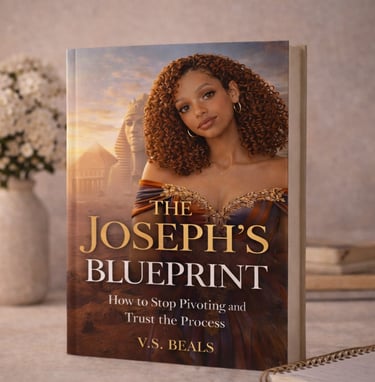
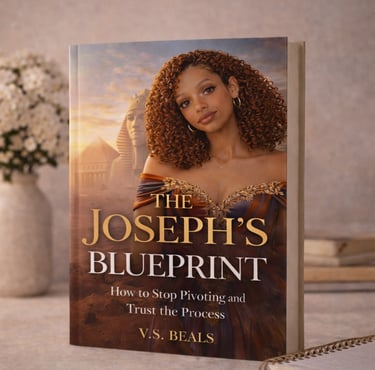
And if you’re ready to stop pivoting and start trusting the process, I created a digital guide called Joseph’s Blueprint. It helps you identify which phase you’re in and what you must not change while you’re there.

Stay faithful. Stay creative. Stay loyal.
V.S. Beals
The Faithful Entrepreneur
V.S Beals
valerie@thefaithfulentrepreneur.store


Ordained Minister · Author of 20+ Published Titles · Toronto, Ontario