
How to Build a Biblical Business Foundation in 7 Days (Even If You're Starting From Zero)
A Step-by-Step Framework for Christian Entrepreneurs Who Want to Stop Rebuilding and Start Operating in Biblical Order
V.S Beals
3/5/202611 min read
If you've ever felt like your business is constantly collapsing — like you're rebuilding every few months, pivoting when you see competitors winning, or changing direction every time revenue dips — you're not alone.
Most Christian entrepreneurs operate in what I call Foundational Disorder.
Not because they lack effort. Not because they lack calling. But because they never installed an operating system. They're building without blueprints. And buildings without blueprints don't stand.
This article will walk you through a 7-Day Biblical Business Structural Foundation — a framework designed to install biblical order in your business, one precept at a time.
By the end of these 7 days, you'll have:
✓ Clarity on your core assignment
✓ Defined non-negotiables that hold under pressure
✓ A stewardship inventory showing what's ready to scale
✓ A stabilized core offer
✓ Revenue sequencing (not just one offer at one price)
✓ A weekly operating structure that produces rhythm (not chaos)
✓ A complete structural diagnostic showing which categories need attention
This isn't theory. This is architectural installation.
Let's start.
Why Most Christian Businesses Collapse (And How to Fix It)
Before we dive into the 7-day framework, you need to understand why most Christian businesses fail.
It's not market conditions.
It's not competition.
It's not even lack of skill.
Most Christian businesses fail because they operate outside of biblical order.
Here's what that looks like:
→ No operating cadence. You work when you feel inspired. You post when urgency hits. You execute sporadically, not rhythmically.
→ Fragmented offers. You change your pricing every month. You pivot your messaging when sales slow. You rotate offers weekly.
→ No revenue sequencing. You have one offer at one price point. If buyers aren't ready for that investment, they leave.
→ Accidental authority. You build visibility episodically. You depend on algorithms. You have no centralized platform.
→ Emotional decisions. You pivot when you see a competitor winning. You discount when revenue dips. You rebrand when comparison hits.
This produces what I call Structural Instability — the business equivalent of a house built on sand. It stands when conditions are calm. But the moment pressure appears (algorithm change, economic shift, personal crisis), it collapses.
Biblical order corrects this.
Not through motivation. Not through tactics. But through systematic installation of structural precepts that hold under pressure.
That's what the next 7 days will do.
What Is the Biblical Business Operating Order™?
Before we start Day 1, let me explain what you're installing.
The Biblical Business Operating Order™ (BBOO) is an 8-framework architectural system that governs how a business operates — regardless of industry, offer, or market conditions.
It's not a course. It's not coaching. It's not inspiration.
It's an operating system.
Think of it like the foundation of a building. You can change the paint, the furniture, the layout — but the foundation remains constant.
The 8 frameworks are:
Operating Authority — What governs decisions when pressure appears
Calling Before Capital — Revenue follows assignment, not the other way around
Stewardship Before Scale — What you can't manage now will destroy you later
Seed, Time, Harvest — Timing is non-negotiable
Multiplication, Not Dependence — What depends on you will break you
Provision Without Corruption — How you earn money determines if it sustains or corrupts
Operating Continuity — You operate inside this Order or outside of it
Non-Negotiables & System Failure — Partial obedience produces partial outcomes
Over the next 7 days, you'll install the foundational precepts from these frameworks.
By Day 7, you'll be ready to take the full Biblical Business Structural Audit™ — a 25-question diagnostic tool that measures your structural stability across 5 categories.
Let's begin.
DAY 1: Define Your Core Assignment
What You're Installing Today:
Calling Before Capital — The first framework in the BBOO system.
Why This Matters:
Genesis 2:15 — "The Lord God took the man and put him in the Garden of Eden to work it and take care of it."
God gave Adam work before provision. The garden was assigned before the fruit appeared. Most Christian entrepreneurs do the opposite. They chase what will pay fastest instead of stewarding what they're called to build. This is why revenue resets every quarter. Capital follows calling — not the other way around. If you don't know your core assignment, every decision becomes emotional. Every pivot feels justified. Every rebrand seems necessary.
But if you do know it, every decision becomes structural.
What You'll Do Today:
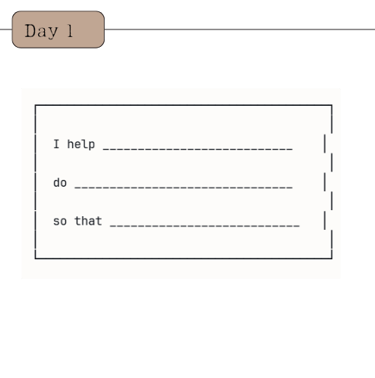
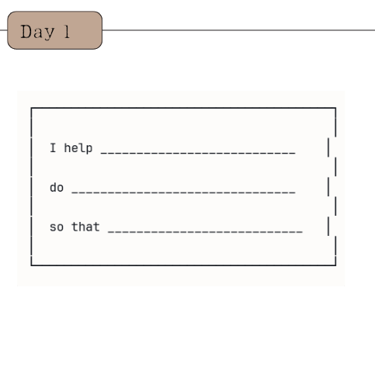
You're going to define your core assignment in one sentence. Not your business description. Not your offer. Not your services. Your calling. Here's the framework:
"I help [WHO] do [WHAT] so that [WHY]."
Example:
"I help Christian women install biblical order in their businesses so they stop rebuilding every quarter."
That's mine. Now write yours.
Worksheet: Calling Clarification
What do you want to be known for in the Kingdom?
Test your statement:
Read it out loud. Does it feel true?
Does it govern your current business decisions?
Would it be true even if you changed your offers?
If you answered "No" to any of these, revise your statement.
Why This Works:
Your calling is the load-bearing wall of your business. Everything else — your offers, your pricing, your marketing — rests on this foundation. Without it, you're building on emotion. With it, you're building on assignment.
Tomorrow, we'll define what you will NOT compromise — even when revenue is at stake.
DAY 2: Identify Your Non-Negotiables
What You're Installing Today:
Non-Negotiables & System Failure — The eighth framework in the BBOO system.
Why This Matters:
1 Samuel 15:22 — "To obey is better than sacrifice."
Partial obedience produces partial outcomes.
Most Christian entrepreneurs have values they claim to hold — but compromise under pressure.
They say they won't discount. Then revenue dips and they run a 50% off sale.
They say they won't work on Sundays. Then a big client needs something and they work anyway.
They say they won't use manipulative marketing. Then they see a competitor using false scarcity and they copy it.
If you don't define your non-negotiables, you'll compromise them.
Not because you're weak. But because you never installed structural boundaries.
What You'll Do Today:
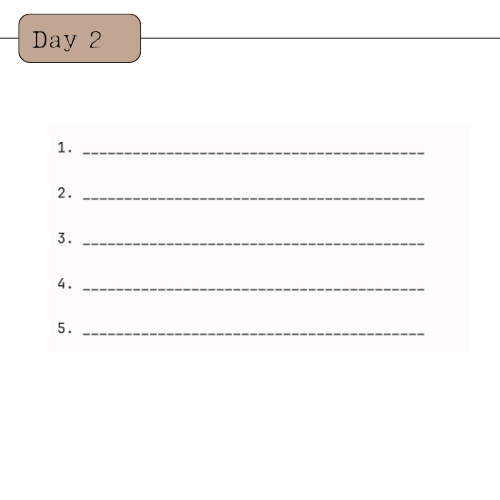
You're going to define 5 non-negotiables — the principles you will NOT change, even for revenue, even under pressure, even when it costs you something.
Worksheet: 5 Non-Negotiables
What will you refuse to change — even for revenue?
Examples to get you started:
I will not compromise biblical integrity for revenue.
I will not work on Sundays.
I will not use manipulative marketing tactics (false scarcity, bait-and-switch).
I will not change my pricing based on urgency.
I will not operate outside of my calling for short-term income.
These are your non-negotiables. Not mine. Write what's true for you.
Why This Works:
These 5 statements become the load-bearing walls of your business. When pressure appears — and it will — you don't have to decide in the moment. The decision has already been made.
Tomorrow, we'll audit what you're currently stewarding — so you know what's ready to scale and what needs to be stabilized first.
DAY 3: Audit Your Stewardship
What You're Installing Today:
Stewardship Before Scale — The third framework in the BBOO system.
Why This Matters:
Luke 16:10 — "He that is faithful in that which is least is faithful also in much."
God does not expand what cannot be stewarded.
Most Christian entrepreneurs are frustrated by lack of growth. But the growth is being withheld — not to punish you, but to protect you. What you can't manage at this level will destroy you at the next level.
If your email list is neglected, your client work is inconsistent, or your finances are a mess — God is holding back expansion because He knows it would crush you.
Stewardship always precedes scale.
What You'll Do Today:
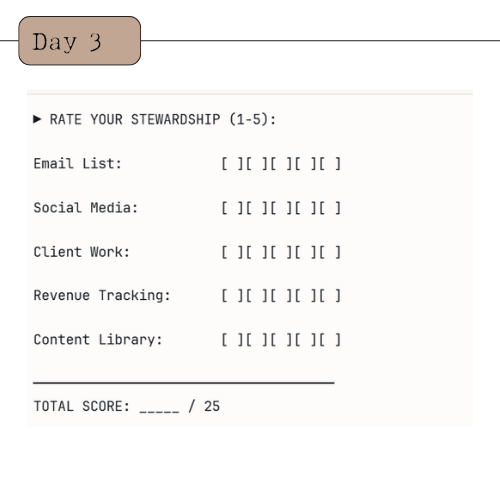
You're going to conduct a stewardship inventory. You'll rate yourself (1–5) in 5 categories:
Email List — Do you nurture it consistently?
Social Media — Do you post with rhythm or reactively?
Client Work — Do you deliver excellent work consistently?
Revenue Tracking — Do you close your books monthly?
Content Library — Is your content organized and accessible?
Worksheet: Stewardship Inventory
What are you stewarding faithfully? What are you neglecting?
Interpretation:
0–10: You are not stewarding what exists. Scale is not safe.
11–18: You are stewarding some things faithfully. Strengthen weak areas before expanding.
19–25: You are stewarding faithfully. You are ready to expand.
Why This Works:
This audit reveals what's ready to scale and what must be stabilized first.
If your score is below 19, you don't need a new offer. You don't need a new strategy. You need to steward what exists before pursuing expansion.
Tomorrow, we'll stabilize your core offer — because offer fragmentation is one of the primary causes of revenue instability.
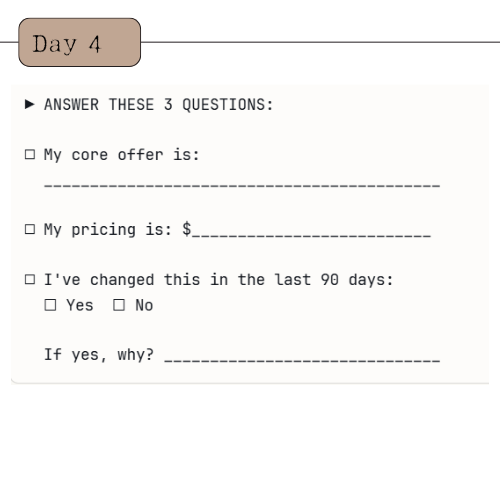
DAY 4: Stabilize Your Core Offer
What You're Installing Today:
Offer Stability — One of the 5 categories measured in the Biblical Business Structural Audit™.
Why This Matters:
Most Christian entrepreneurs have fragmented offers. They sell multiple things. They change pricing frequently. They adjust messaging based on urgency. This produces scattered positioning and low conversion. Buyers can't trust what you sell because you don't trust it either.
Offer stability produces revenue reliability.
If you want predictable income, you need a stabilized core offer — one primary revenue driver with clear positioning, consistent pricing, and messaging that a stranger can understand.
What You'll Do Today:
You're going to identify your core offer and audit its stability.
Worksheet: Offer Stability Checklist
Have you changed your offer in the last 90 days? If yes, why?
Offer Stability Test:
Can a stranger read your Instagram bio or website homepage and immediately understand:
What problem you solve?
Who you serve?
What you offer?
If the answer is "No" to any of these, you have offer fragmentation.
Why This Works:
When you stabilize your core offer, your messaging becomes clear. Your positioning becomes sharp. Your revenue becomes predictable. You're no longer confusing buyers with 5 different offers rotating weekly.
You have one primary offer — and everything else supports it.
Tomorrow, we'll map your revenue sequencing — because single-point revenue limits scale.
DAY 5: Map Your Revenue Sequencing
What You're Installing Today:
Revenue Structure — One of the 5 categories measured in the Biblical Business Structural Audit™.
Why This Matters:
Most Christian entrepreneurs have single-point revenue. They have one offer at one price point. If the buyer isn't ready for that investment, they leave. This limits scale and creates revenue volatility. Revenue sequencing solves this.
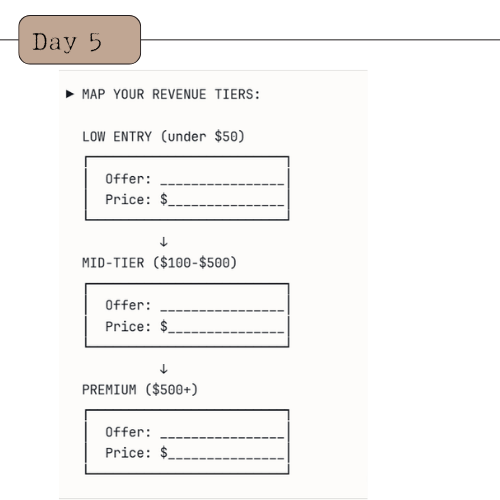
Instead of one offer at one price, you have three tiers:
Low entry point (under $50)
Mid-tier offer ($100–$500)
Premium offer ($500+)
This allows buyers to ascend predictably — and your revenue to scale.
What You'll Do Today:
You're going to map your current revenue structure and identify missing tiers.
Worksheet: Revenue Sequencing Template
Do you have one offer at one price point — or sequenced monetization?
Which tier is missing?
☐ Low entry point
☐ Mid-tier offer
☐ Premium offer
When will you create the missing tier?
Target date: __________________
Why This Works:
Revenue sequencing creates an ascension path. Buyers who aren't ready for your $500 offer can start with your $27 offer. Then they move to your $147 offer. Then they invest in your $500 offer. This is how you scale without constantly chasing new buyers.
Tomorrow, we'll measure your operating cadence — because rhythm produces sustainability.
DAY 6: Measure Your Operating Cadence
What You're Installing Today:
Operating Cadence — One of the 5 categories measured in the Biblical Business Structural Audit™.
Why This Matters:
Most Christian entrepreneurs operate in chaos.
No weekly structure. No recurring tasks. No cadence. They post when inspired. They work when urgent. They track nothing. Then they wonder why momentum collapses every quarter. Operating cadence is the difference between reactive and rhythmic execution. Reactive execution = bursts of effort followed by collapse. Rhythmic execution = consistent, sustainable progress that compounds.
What You'll Do Today:
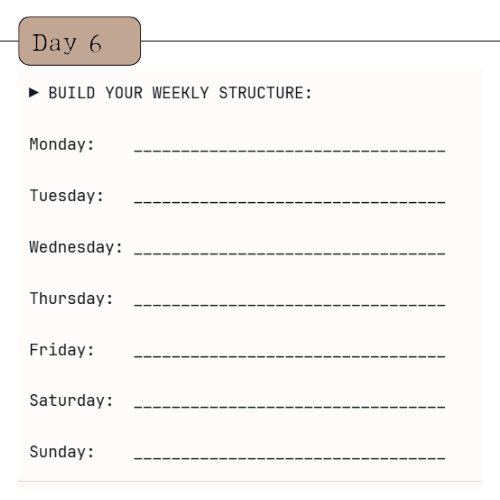
You're going to build a weekly operating structure — a simple rhythm that governs your execution.
Worksheet: Weekly Operating Structure
Do you execute in rhythm or react emotionally?
Examples to get you started:
Monday: Plan week, batch content
Tuesday: Client work, post on Instagram
Wednesday: Email newsletter, engagement
Thursday: Client work, post on Facebook
Friday: Admin, close books, plan next week
Saturday: Family/rest
Sunday: Sabbath (no work)
This is your rhythm. Not mine. Build what's sustainable for you.
Why This Works:
When you operate in rhythm, execution becomes inevitable. You're not waiting for inspiration. You're not reacting to urgency.
You have a structure — and you execute inside it.
Tomorrow, you'll take the full Biblical Business Structural Audit™ — a complete diagnostic that measures all 5 categories and shows you exactly what needs to be installed next.
DAY 7: Take the Full Structural Audit
What You're Installing Today:
Complete Structural Diagnostic — The Biblical Business Structural Audit™.
Why This Matters:
You've installed 6 foundational precepts over the last 6 days:
✓ Core Assignment
✓ Non-Negotiables
✓ Stewardship Inventory
✓ Offer Stability
✓ Revenue Sequencing
✓ Operating Cadence
Now it's time to measure how well your business is operating across all 5 structural categories.
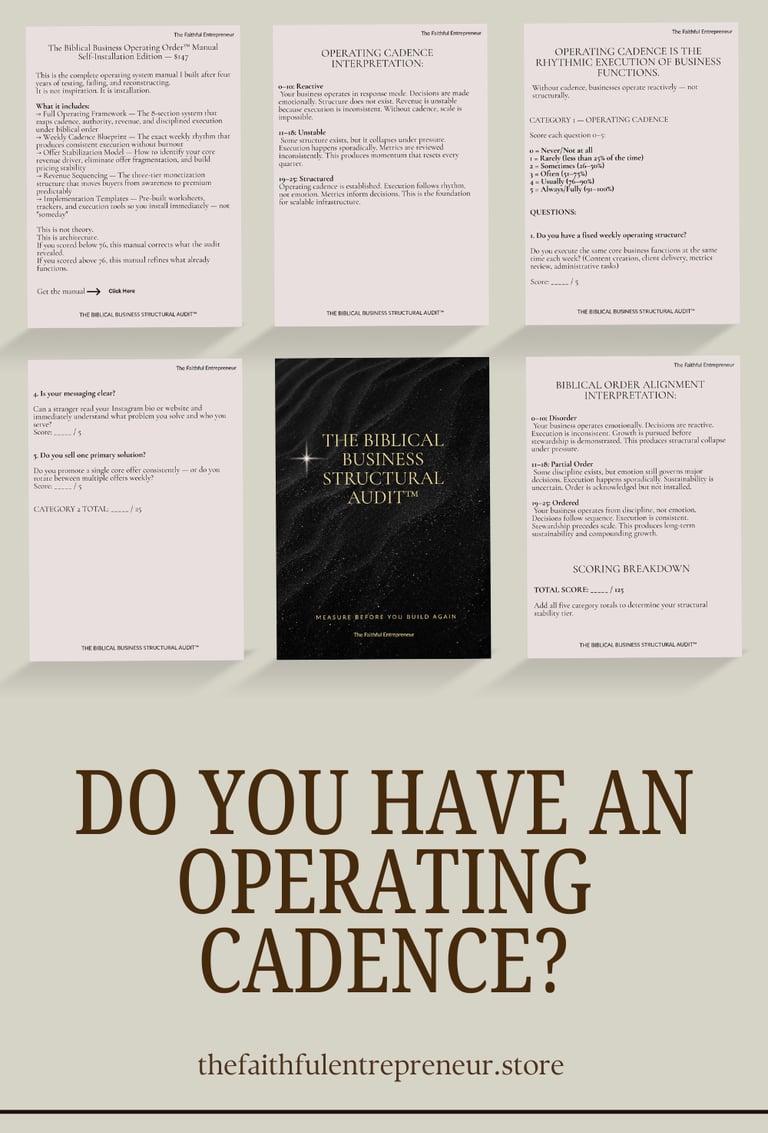
The Biblical Business Structural Audit™ is a 25-question diagnostic tool that measures:
Operating Cadence — Do you execute in rhythm or react emotionally?
Offer Stability — Is your positioning clear or fragmented?
Authority Infrastructure — Are you building visibility systematically?
Revenue Structure — Do you have sequenced monetization?
Biblical Order Alignment — Are decisions made from discipline or emotion?
Your score (0–125) places you in one of four tiers:
0–40: Foundational Disorder — No structure. Constant rebuilds.
41–75: Structural Instability — Some structure, collapses under pressure.
76–100: Developing Order — Structure holds, gaps remain.
101–125: Scalable Foundation — Operating in disciplined sequence.
What You'll Do Today:
Take the free audit. It takes 10 minutes. You'll answer 25 questions (5 per category). Each question is scored 0–5.
At the end, you'll receive:
✓ Your structural stability score (0–125)
✓ Your tier diagnosis
✓ Your category breakdown (showing weakest areas)
✓ A custom roadmap showing what to install next
Take the Biblical Business Structural Audit™
What Happens After You Take the Audit?
Once you complete the audit, you'll know exactly where you stand.
You'll see which tier you're in. You'll see which categories are causing collapse. You'll see what needs to be installed next.
Here's what to do based on your score:
If you scored 0–40 (Foundational Disorder):
Start with the Complete Installation Toolkit ($73). It includes:
30-Day Quick-Start Checklist
90-Day Operating Cadence Tracker
5 Implementation Worksheets
This installs foundational biblical order without overwhelming you.
If you scored 41–75 (Structural Instability):
Get the Biblical Business Operating Order™ Manual ($147). It's the complete 80-page operating system with all 8 frameworks, implementation worksheets, and architectural blueprints.
This corrects what the audit revealed.
If you scored 76–100 (Developing Order):
Get the manual and add the 90-Day Operating Cadence Tracker ($27) to track your progress.
If you scored 101–125 (Scalable Foundation):
Apply for the 90-Day Founding Cohort ($397). You're ready for guided installation, live implementation calls, and advanced revenue architecture training.
Final Thought: You Are Not Stuck
If you're reading this, you're not stuck. You're being prepared.
Joseph wasn't stuck in Potiphar's house. He was learning stewardship.
He wasn't stuck in prison. He was being refined.
What you call "stuck," God calls "strategic."
Stop treating delay like defeat. Start treating it like preparation.
And while you wait — install the structure you'll need when the door opens.
The 7-day framework you just completed is your foundation.
The Biblical Business Structural Audit™ is your diagnostic.
The Biblical Business Operating Order™ is your complete operating system.
Take the audit. See your score. Install what's missing.
Take the Free Biblical Business Structural Audit™
10 minutes. 25 questions. Complete structural diagnostic.
Related Articles
Stay faithful. Build in order. Operate with discipline.
With clarity and fire,
V.S. Beals
Biblical Business Systems Architect
V.S Beals
valerie@thefaithfulentrepreneur.store


Ordained Minister · Author of 20+ Published Titles · Toronto, Ontario