
7 Biblical Business Principles from Ruth Every Kingdom Woman Should Know
7 powerful business principles woven through the Book of Ruth and learn how her obedience, excellence, and faith can guide your journey as a Christian woman in business. This article breaks down Ruth’s story into practical strategies for building with God.
V.S Beals
11/25/20257 min read
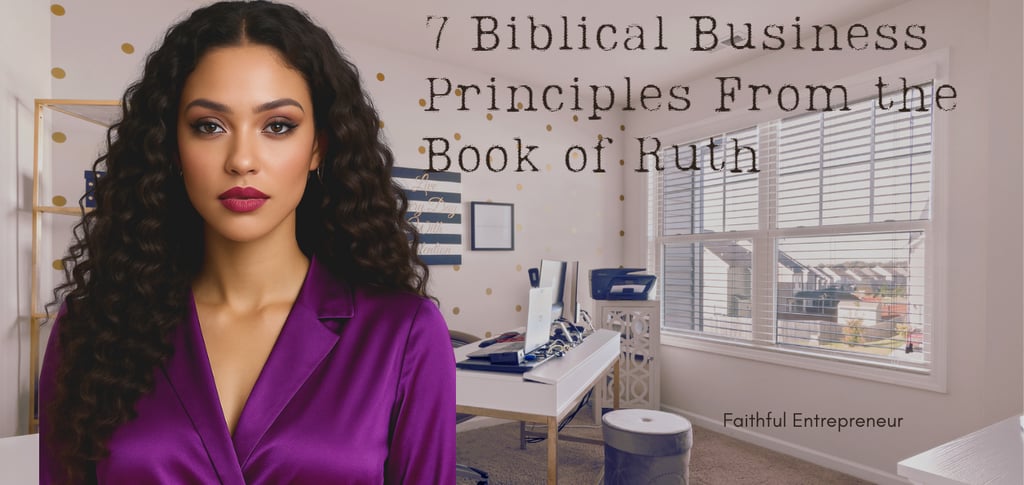
When women talk about the Book of Ruth, they talk about love stories. They talk about Boaz. They talk about redemption and restoration and favour that finds you in the field. But they rarely talk about what the story actually is: which ia a blueprint for women who are trying to rebuild their lives with God, one day at a time, while learning how to steward their purpose in the middle of real-life pressure. Your problems don't just go away because you chose to follow Christ, no if anything the enemy attacks you harder because you broke his chain. Ruth didn’t step into a fairytale either. She stepped into a foreign land with no money, no stability, no security, and no idea what tomorrow would look like. Let's not forget that she was a widow with no child. And still, God turned her obedience into a legacy.
If you’re building a business with God, Ruth is not just a story you read for inspiration. She’s the sister you study for strategy. Her story shows you how to move when life is heavy, how to work with wisdom when resources are small, how to walk with integrity when no one is watching, and lastly, how to work your field until God changes your life through it. These are the seven biblical business principles woven directly through her story—principles that will guide any woman trying to honour God with her hands and build something that outlives her. Her legacy.
Business Principle 1
The first principle from the Book of Ruth is that she teaches you how to move forward when everything in your life feels like it has collapsed. In chapter one, Ruth shows us a woman who has buried a husband, walked away from her community, and stepped into a land where she has no reputation, no stability, and no plan except this: “Your people shall be my people, and your God my God” (Ruth 1:16). That’s not romance. That’s grit. That’s the kind of decision a woman makes when she knows her life cannot stay the same. She didn’t have a business plan. She didn’t have clarity. She didn’t have a step-by-step strategy. She simply obeyed the pull of God and moved into her next season. That is biblical business principle number one: you don’t wait for your circumstances to be comfortable before you move. You move because God is calling you, even if all you have is the faith that your next step will not be wasted.
Business Principle 2
The second principle is demonstrated when Ruth positions herself with a servant’s heart, not entitlement or desperation. In Ruth 2, she says to Naomi, “Let me now go to the field, and glean ears of corn after him in whose sight I shall find grace” (Ruth 2:2). She didn’t ask to be handed anything. She didn’t complain about her situation. She didn’t sit in the house rehearsing her pain. She volunteered for the most unglamorous labour available and did it with dignity. Gleaning was hard work. Back-breaking work. Low-status work. But Ruth approached it with a posture of service. And that posture granted her access to favour. This principle matters in business because God promotes women who work with humility, not competition. A servant’s heart will always draw opportunities that a striving spirit never will. This reminds me of the gospel song I wrote, I don't hustle no more (you probably heard it in the background of my Youtube Videos).
Business Principle 3
Our third business principle shows up when Ruth enters a field she has no experience in. She wasn't raised a gleaner. She wasn’t trained in agriculture. She didn’t understand Israelite customs or harvesting traditions. And she definitely didn't know anyone in that field.But she walked into a new industry and learned through doing. Many women delay their God-given assignments because they believe they must become experts before they even begin. Hey, I am not knocking that, especially since I was that woman once upon a time too. That's why i'm here to share my testimony. Ruth shows us that God often trains you in the field, not in the theory (as he did me, and He will you too). In Ruth 2:3 it says she “happened” to come to the part of the field belonging to Boaz, but nothing about it was accidental. God guided her obedience, not her expertise. When you start before you feel qualified, God sends the right people, the right resources, and the right guidance into your path—just as He sent Boaz to notice her.
Business Principle 4
The fourth biblical business principle is excellence. Ruth didn’t do the bare minimum. She gleaned “from morning until now” (Ruth 2:7), and Boaz noticed not because she was loud, but because she was focused. Excellence is quiet. Excellence speaks without words. Excellence builds a reputation before you ever build a brand. When Ruth gleaned in that field, she wasn’t planning to be seen. She wasn’t trying to impress anyone. She wasn’t networking. She was simply doing her work with diligence, and that diligence opened the door for Boaz to bless her. In business, you cannot ask God to bless work you refuse to give your best effort to. The issue that majority of us have is that we are the ones trying to make our name great. When what we should focus on is providing services and products that serves our customers more than the exchange of financial gain will serve us. Ruth’s story teaches that favour follows faithfulness.
Business Principle 5
The fifth principle is obedience to godly counsel. Naomi was not just Ruth’s mother-in-law. She was a spiritual mentor, a woman who understood the laws, customs, and prophetic signs of Israel. When Naomi gave Ruth specific instructions in Ruth chapter 3—where to go, when to go, how to present herself—Ruth didn’t debate it, argue it, or modify it to fit her comfort. She said, “All that thou sayest unto me I will do” (Ruth 3:5). That is a business principle many women overlook. You are not meant to build alone. You need wisdom from someone who has walked with God longer, who sees what you cannot see, who can guide you through seasons you do not yet have the experience for. Naomi didn’t just encourage Ruth; she positioned her. And Ruth’s obedience unlocked an entirely new chapter of her life.
Business Principle 6
The sixth principle we're going to look at is alignment over isolation. Ruth’s story is filled with divine partnerships. Ruth aligned with Naomi. Naomi aligned with Boaz’s lineage. Ruth aligned with Boaz. And Boaz aligned with the law and redeemed her. Every business story that succeeds is built on relationships. Not the shallow, transactional ones, but the God-sent ones. In chapter 2, it shows us that community is not optional for kingdom women; it is the place where God hides your next level. Boaz did not replace God. He was the vessel God used to reward Ruth’s obedience. If you’re trying to build everything alone, you are rejecting one of the primary ways God delivers provision, instruction, and favour.
Business Principle 7
The final principle is legacy. Ruth’s story doesn’t end with marriage. It ends with lineage. In chapter 4, the Word shows us that Ruth becomes the great-grandmother of King David, and from her line comes Jesus Christ. That’s legacy at its finest. That’s generational impact born from one woman deciding to obey God in the small things. When you build with God, you’re not just building for yourself. You’re building for the children you have, the children you don’t have yet, and the generations that will come long after you’re gone. Ruth thought she was gleaning to survive. God was positioning her to birth a royal dynasty. The same applies to you. What looks small right now—your business idea, your early sales, your tiny audience—may be the foundation of a legacy heaven has already written your name into.
When you study Ruth through the lens of biblical business, you'll soon discover a woman who embodies consistency, humility, teachability, excellence, obedience, alignment, and legacy. These principles are not outdated. They are the backbone of building anything meaningful with God. Ruth’s life teaches us that God does not need you to be perfect. He needs you to be faithful. He needs you to move when it’s hard, work when it’s quiet, listen when He sends guidance, and align with the people He places in your path. And if you do those things, God will take the small field you’re gleaning in today and turn it into the future you’ve been praying for.
Stay faithful, stay loyal, and stay creative.
With love and fire,
V.S. Beals
Writer. Watchwoman. Woman of the Word.


If you're wanting a digital Bible and complete journal
Ready to apply these principles to your business?
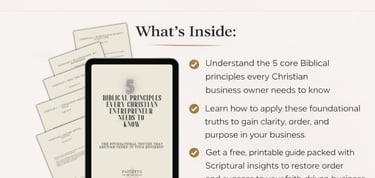
Start with the free guide: 5 Biblical Principles Every Christian Entrepreneur Needs to Know.
This 7-page PDF gives you the foundation. The Biblical Business Operating Order gives you the full system.
Download the free guide here →
Or, if you're ready for the complete system:
V.S Beals
valerie@thefaithfulentrepreneur.store


Ordained Minister · Author of 20+ Published Titles · Toronto, Ontario