
What Is a Business Audit? (And Why Every Christian Entrepreneur Needs One)
A business audit measures structural stability. Most Christian entrepreneurs rebuild emotionally but never audit structurally. Learn how often to conduct audits, why they matter, and what they reveal.
V.S Beals
2/28/20267 min read


You've rebranded. You've repositioned. You've launched new offers. But revenue still fluctuates. Momentum still resets. Structure still collapses. The problem isn't effort. The problem is you've never measured what exists. Most Christian entrepreneurs rebuild emotionally but never audit structurally. They change messaging. They change offers. They change direction. But they do not measure the foundational gaps causing rebuild cycles. That's what a business audit does. It measures before you build again.
WHAT IS A BUSINESS AUDIT?
A business audit is a diagnostic measurement tool that evaluates the structural integrity of your business. It is not a motivational worksheet. It is not a vision-casting exercise. It is not a strategic planning session.
A business audit measures what currently exists — not what you hope to build.
It asks:
Does your business operate in rhythm or react emotionally?
Is your positioning clear or fragmented?
Are you building visibility systematically or accidentally?
Do you have sequenced monetization or single-point dependence?
Are decisions made from discipline or emotion?
A business audit reveals the structural gaps causing revenue instability, rebuild cycles, and operational chaos.
WHY MOST CHRISTIAN ENTREPRENEURS SKIP AUDITS
Most Christian entrepreneurs skip audits for three reasons:
Reason 1: They Mistake Activity for Progress
They assume that because they're working hard, the business is structurally sound. But effort does not equal stability. You can work 60 hours a week and still operate in foundational disorder. Activity without structure produces exhaustion, not sustainability.
Reason 2: They Assume Audits Are for "Big Businesses"
They think audits are only for corporations, franchises, or seven-figure companies. But audits are most critical for small businesses and solopreneurs.
Why?
Because small businesses collapse faster when structure is missing. Corporations have systems that hold even when execution is weak. Solopreneurs do not. If you're the only person running your business, you need audits more — not less.
Reason 3: They're Afraid of What the Audit Will Reveal
This is the real reason. Most Christian entrepreneurs avoid audits because they don't want to face the truth:
Their offers are unstable
Their revenue is unpredictable
Their execution is inconsistent
Their decisions are made emotionally
But avoiding measurement doesn't eliminate the problem. It just delays the inevitable collapse.
WHAT A BUSINESS AUDIT MEASURES
A comprehensive business audit measures five structural categories:
Category 1: Operating Cadence
What it measures: The rhythmic execution of business functions.
Why it matters: Without cadence, businesses operate reactively — not structurally.
Questions it asks:
Do you have a fixed weekly operating structure?
Do you review metrics weekly?
Do you produce content on a scheduled cadence?
Is your revenue tracked monthly?
Do you pivot emotionally?
What it reveals: Whether your business operates in rhythm or responds to urgency.
Category 2: Offer Stability
What it measures: The consistency of what you sell and how you position it.
Why it matters: Without offer stability, messaging fragments and revenue becomes unpredictable.
Questions it asks:
Have you changed your core offer in the last 90 days?
Do you know your core revenue driver?
Is your pricing consistent?
Is your messaging clear?
Do you sell one primary solution?
What it reveals: Whether buyers trust what you sell — or whether you don't trust it either.
Category 3: Authority Infrastructure
What it measures: The systematic building of trust, visibility, and credibility.
Why it matters: Without infrastructure, audience growth is accidental — not architectural.
Questions it asks:
Do you have one central traffic platform?
Do you capture emails consistently?
Is your messaging repeated weekly?
Do you publish long-form content?
Is your audience growing monthly?
What it reveals: Whether authority is being built systematically — or whether it depends on luck.
Category 4: Revenue Structure
What it measures: The sequenced monetisation path from awareness to premium.
Why it matters: Without structure, revenue depends on single-point conversion — which limits growth.
Questions it asks:
Do you have a clear funnel?
Is there a low entry point?
Is there a mid-tier offer?
Is there a premium offer?
Do you track conversion rates?
What it reveals: Whether revenue compounds as audience grows — or whether it stays flat.
Category 5: Biblical Order Alignment
What it measures: Whether your business operates from discipline or emotion.
Why it matters: This is not theological assessment. This is structural measurement.
Questions it asks:
Is your business built on stewardship or impulse?
Are decisions made from discipline or emotion?
Is there sequence in your execution?
Do you operate consistently or episodically?
Is your business sustainable?
What it reveals: Whether your business will hold under pressure — or collapse when circumstances shift.
HOW OFTEN SHOULD YOU CONDUCT A BUSINESS AUDIT?
For new businesses (0–2 years): Every 90 days
Why: New businesses pivot frequently. Quarterly audits prevent emotional rebuilds and keep structure intact.
For established businesses (3–5 years): Every 6 months
Why: Established businesses need less frequent audits but still require regular structural measurement to prevent drift.
For scaling businesses (5+ years or 6-figure+): Annually + after major changes
Why: Scaling businesses operate in relative stability. Annual audits maintain structure. Additional audits are needed after major changes (new offers,
Decisions are made emotionally, not structurally.
What this means: Without foundational order, scale is impossible.
What to do next: Install the missing systems before pursuing growth.
Tier 2: Structural Instability (41–75 points)
Some infrastructure exists, but it collapses under pressure.
Execution is inconsistent.
Revenue exists but fluctuates.
Authority is building slowly.
Emotional decision-making still governs major pivots.
What this means: Momentum resets repeatedly. Stability requires installation of missing systems.
What to do next: Identify which categories scored lowest. Install the missing frameworks in those areas.
Tier 3: Developing Order (76–100 points)
Operating structure is present.
Offers are stabilizing.
Revenue is predictable.
Authority infrastructure is functioning.
Decisions are increasingly disciplined.
What this means: Gaps remain, but the foundation is solid. Refinement and optimization will produce scalable growth.
What to do next: Refine execution in weak categories. Optimize what already functions.
Tier 4: Scalable Foundation (101–125 points)
Your business operates in disciplined sequence.
Cadence is consistent.
Offers are stable.
Revenue is structured.
Authority compounds monthly.
Decisions are made from data and strategy, not emotion.
What this means: This foundation supports long-term scale without structural collapse.
What to do next: Maintain current structure. Prepare for advanced revenue architecture and seven-figure positioning.
Grab Your Free Business Structure Audit
WHY BIBLICAL ORDER MATTERS IN BUSINESS AUDITS
Most business audits measure metrics.
Revenue. Profit. Traffic. Conversion rates.
But metrics don't reveal structure.
Metrics tell you what happened. Structure tells you why it happened — and whether it will happen again.
Biblical order audits measure the underlying architecture that produces metrics.
For example:
A traditional audit asks: How much revenue did you generate last month?
A biblical order audit asks: Was that revenue generated from discipline or desperation?
Why the difference matters:
Revenue generated from discipline is repeatable.
Revenue generated from desperation is not.
Another example:
A traditional audit asks: How many social media followers do you have?
A biblical order audit asks: Do you have one central traffic platform — or are you scattered across multiple platforms inconsistently?
Why the difference matters:
Scattered effort produces random visibility.
Centralized effort produces compounding authority.
Biblical order audits measure what traditional audits miss: structural sustainability.
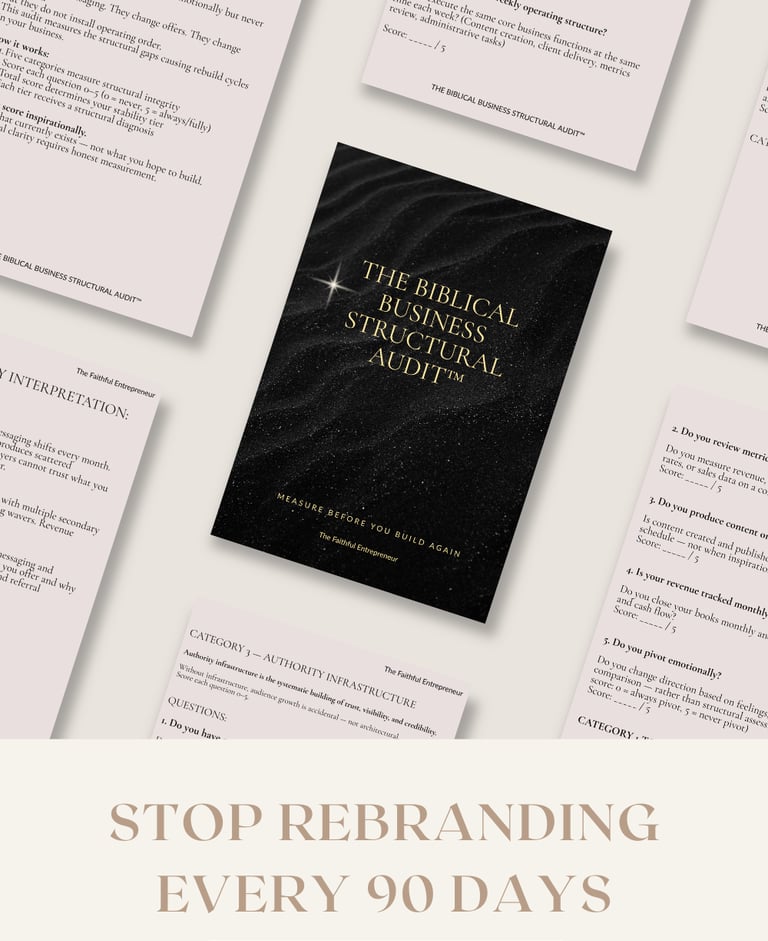
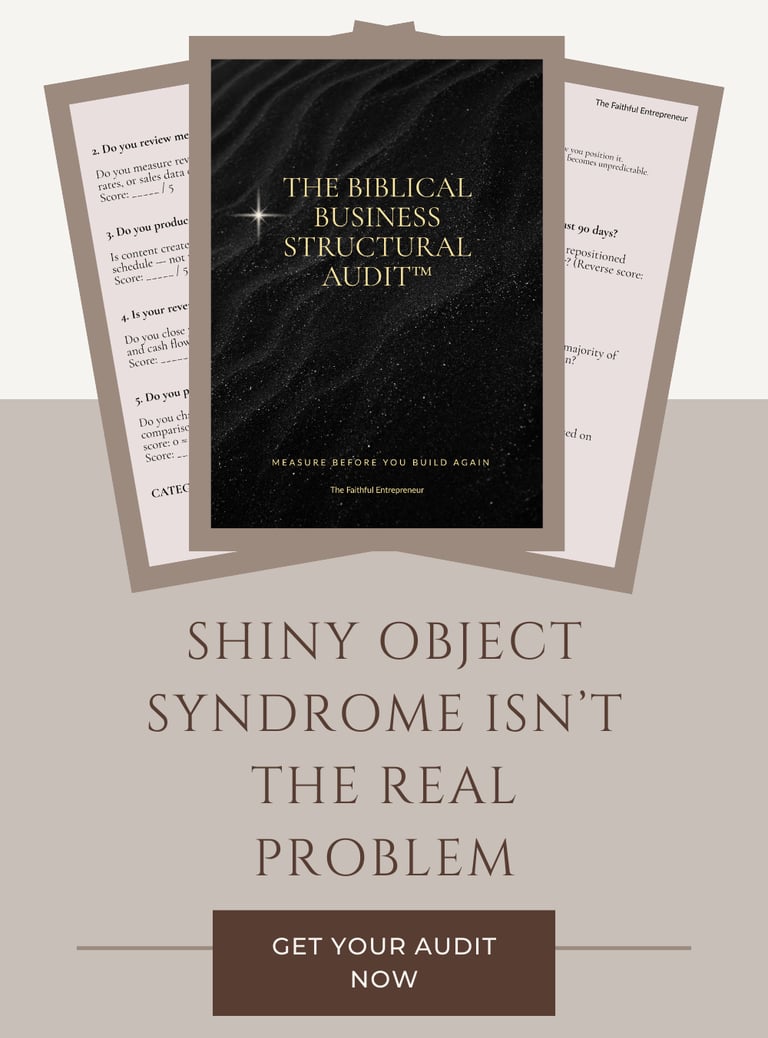
THE BIBLICAL BUSINESS STRUCTURAL AUDIT™
I created The Biblical Business Structural Audit™ after four years of rebuilding, testing, failing, and reconstructing. It is not a motivational worksheet. It is a diagnostic weapon.
What it measures:
Operating Cadence
Offer Stability
Authority Infrastructure
Revenue Structure
Biblical Order Alignment
What it reveals:
Your structural stability tier (0–125 points)
Which categories are causing collapse
What must be installed next
What it does not do:
Give you a pep talk
Tell you to "believe in yourself"
Provide vague inspiration
What it does:
Deliver clarity fast
Expose structural gaps
Create controlled discomfort
Make the solution inevitable
The audit is free.
It takes 10–15 minutes to complete.
And it will show you why your business keeps collapsing — even when you're working harder than ever.
Grab Your Free Business Structure Audit
WHAT TO DO AFTER THE AUDIT
IF YOU SCORED 0–75:
Your business operates in foundational disorder or structural instability.
The next step is installation.
Start with the Biblical Business Quick-Start Checklist ($27) — a 30-day action plan that installs biblical order without overwhelm.
Not ready to buy? That's okay. Save your audit results and come back when you're ready.
IF YOU SCORED 76–100:
Your business has developing order, but gaps remain.
The next step is optimization.
Get the Biblical Business Operating Order™ Manual ($147) — the complete 8-section operating system that refines what already functions.
IF YOU SCORED 101–125:
Your business operates on scalable foundation.
The next step is advanced architecture.
Get the Biblical Business Operating Order™ Manual ($147) to sharpen execution, then join the 90-Day Founding Cohort ($397) for guided installation of seven-figure positioning.
START WHERE YOU ARE. INSTALL WHAT'S MISSING. SCALE WHEN YOU'RE READY.
You cannot fix what you do not measure.
Most Christian entrepreneurs rebuild emotionally but never audit structurally. They change direction based on feelings. They pivot based on comparison. They restart based on urgency.
But without measurement, you don't know if the pivot is correction or chaos.
A business audit removes the guesswork. It shows you what exists. It reveals what's missing. It eliminates emotional decision-making.
If you've rebuilt more than once, you don't need convincing. You need structure. Take the free audit. Measure before you build again.
The Business Audit Is An Instant Download - Grab It Today & Thank Me Later
Stay faithful. Build in order. Operate with discipline.
With clarity and fire,
V.S. Beals
Biblical Business Systems Architect
Grab Your Business Structure Audit Today
The audit is free.
It takes 10 minutes.
And it will show you why your business keeps collapsing — even when you're working harder than ever.


V.S Beals
valerie@thefaithfulentrepreneur.store


Ordained Minister · Author of 20+ Published Titles · Toronto, Ontario